
The short answer
Win loss analysis examines completed buying decisions to understand why an offer was selected, rejected or left undecided. Combine outcome records with accounts from people involved, compare similar situations, and distinguish supported explanations from questions that still need evidence.
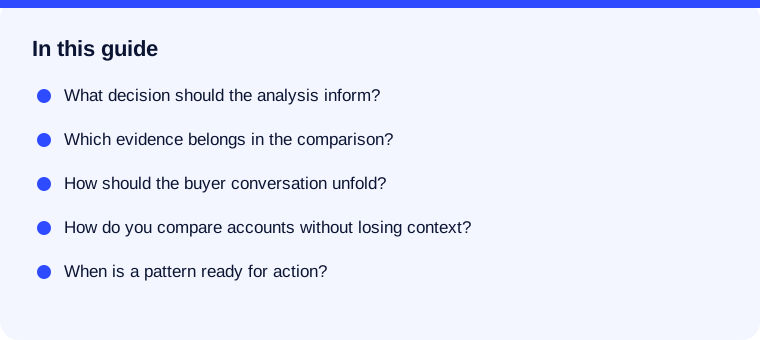
What decision should the analysis inform?
Start with a decision your team can make, such as which evaluation requirement to investigate or which part of an offer needs clarification. Avoid beginning with a preferred explanation for lost business. Write the current belief and the evidence that would challenge it.
Define a time period, offer version and buying context. Keep completed purchases, choices of a different option and decisions to make no change in separate categories. Mark unresolved evaluations separately so they do not silently become losses. These are proposed organizing rules for your study, not universal outcome definitions.
A win rate is a count with a denominator; an explanation of a decision is a different kind of evidence. If you report won decisions divided by won plus lost decisions, state that definition and report excluded or unresolved cases separately. Do not calculate a business win rate from a deliberately selected interview sample.
Which evidence belongs in the comparison?
Use the following original planning table to assign a purpose to each kind of material. A source can be useful without being sufficient on its own.
| Material | Use in this study | Question to keep open |
|---|---|---|
| Outcome record | Establish the recorded decision and date | Does the status match what actually happened? |
| Evaluator account | Reconstruct requirements and comparisons | Which events did this person personally see? |
| Approver account | Understand decision conditions | Which earlier discussions did they miss? |
| Contrasting case | Examine the same issue under another outcome | Are the contexts sufficiently comparable? |
Record relevant experience rather than treating a job title as proof of involvement. Include missing perspectives in the report. Access to people involved in particular past decisions must be confirmed before committing to the study scope.
How should the buyer conversation unfold?
GOV.UK interview guidance recommends open, neutral questions and concrete experiences. Apply that principle by asking for the sequence of a completed evaluation before suggesting reasons for its outcome.
- What changed that made an evaluation worth starting?
- Which requirements did you personally help define?
- What options were seriously considered, including continuing the current approach?
- When did the preferred direction become clearer, and what happened then?
- What did you observe about the final decision, and what did you only hear later?
If price appears in the account, ask what it was compared with and at which stage. If a requirement appears, ask when it became decisive. Preserve uncertainty instead of pressing for a single definitive reason. Use the customer interview question guide for additional neutral follow-ups.
How do you compare accounts without losing context?
GOV.UK analysis guidance separates observations from interpretation and subsequent actions. The worksheet below applies that distinction to buying decisions. All entries are hypothetical examples, not measured findings.
| Outcome and observation | Proposed explanation | Contrary or missing evidence | Next check |
|---|---|---|---|
| No change: evaluator describes unassigned implementation responsibility | Ownership may have blocked progress | Approver perspective is missing | Investigate who could authorize the work |
| Purchase: evaluator describes ownership being agreed early | Clear ownership may have helped | Scope and urgency also differed | Compare cases with similar scope |
| Alternative chosen: participant recalls a price concern | Total cost may have mattered | It is unclear whether the packages were comparable | Clarify what was included in the comparison |
For your own study, add an anonymous case code, offer version, event date, participant role in the decision and supporting note. Use one row per explanation rather than one label per deal. Retain counterexamples and unresolved accounts alongside repeating themes.
When is a pattern ready for action?
Review whether the explanation rests on firsthand accounts, whether it recurs in comparable situations and whether a contrasting case challenges it. Classify it as supported within the observed cases, contradicted, or unresolved. These labels organize a judgment; they are not statistical confidence scores.
A repeated reason in selected interviews does not establish its prevalence across all buyers. Nor does a contrast between wins and losses establish that changing one feature will change outcomes. State who participated, which decisions are missing and which offer versions were examined.
Write each recommendation as a bounded next step: clarify a requirement, investigate another decision role, test a revised explanation, or gather a missing case. Assign responsibility for reviewing the evidence and record what result would change the recommendation.
What should a research brief ask for?
Specify the completed decision context, firsthand experience required, outcomes to compare and the output you need. Agree who is responsible for conducting the sessions and interpreting the evidence. Keep any later commercial discussion separate from the research purpose.
Wavelength helps companies hold buyer conversations, customer discovery and market-insight sessions with people in their ICP. Discuss audience feasibility through B2B research recruitment; do not assume access to participants from specific past evaluations. If the underlying problem is still uncertain, start with customer discovery interviews before defining retrospective outcome research.
Talk with Wavelength about the buyers you need to meet
Wavelength helps technology companies hold research conversations with relevant executives and operators in their ICP, for customer discovery, product feedback and market insight. Read about our B2B research recruitment service, or tell us about the audience you want to learn from.
Tell us who you want to meetCommon questions
Is win loss analysis only about losses?
No. Define the comparison around your decision. Won, lost and no-change outcomes can reveal different conditions, provided the cases are compared in context.
Can interview counts replace outcome records?
No. A selected interview set is useful for examining explanations. Use clearly defined outcome records and denominators for business rates.