
The short answer
Concept testing evaluates a proposed product, service or change with its intended audience before treating the idea as settled. A qualitative concept conversation explores what people think the idea does, where it fits and what would need to be true for them to use it. This guide provides a preparation worksheet, not a demand forecast.
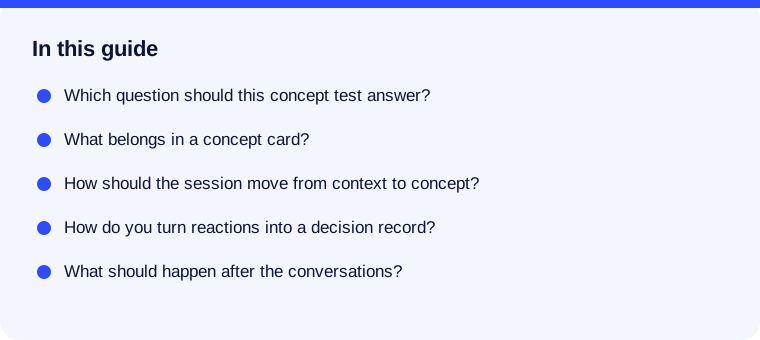
Which question should this concept test answer?
Describe the decision you face before choosing a method. You might be deciding whether to revise an idea, investigate a dependency or compare different approaches to a problem. Write down what evidence would cause you to reconsider your preferred direction.
| Decision | Useful study focus | Boundary |
|---|---|---|
| Is the problem understood? | Explore recent experiences before showing an idea | Begin with discovery if the problem is still unclear |
| Where could this proposed change fit? | Discuss a consistent concept with relevant people | Keep reactions separate from commitments |
| How do audience segments rate alternatives? | Plan a structured comparison and suitable sampling | This worksheet does not specify survey sample sizes |
| Can people complete a task with a design? | Plan a separate task-based usability study | A description alone cannot establish task performance |
What belongs in a concept card?
Use a short description or sketch that explains the proposed change without presenting it as an existing capability. Keep the detail comparable when showing alternatives. An elaborate illustration of one option beside a vague sentence about another makes the comparison difficult to interpret.
- Situation: the activity or problem the idea concerns.
- Audience: the person affected and their relevant experience.
- Change: what would become possible or different.
- Dependencies: what would need to be available, approved or learned.
- Version: the exact material shown during the session.
Leave unknowns visible. Do not fill gaps with unsupported performance promises. If a question exposes a missing assumption, record it before revising the card.
How should the session move from context to concept?
GOV.UK guidance on in-depth interviews advises focusing on concrete experiences and using neutral follow-ups. Begin by asking about a recent relevant situation, then introduce the concept as a proposal to examine.
- What happened the last time you faced this situation?
- What do you think this proposed idea would change?
- Where would it fit into the situation you described?
- What would remain difficult or unresolved?
- What else would need to be true before you could consider using it?
Record the participant’s initial explanation before correcting a misunderstanding. Keep the original response and the clarification distinct. If the participant has no relevant experience, preserve that limitation rather than asking them to imagine an authoritative answer.
How do you turn reactions into a decision record?
Use this original assumption ledger. The entries are hypothetical teaching examples. Replace them with study notes and keep contrary evidence in the same record as supportive comments.
| Assumption | Possible observation | Next decision | Still unknown |
|---|---|---|---|
| The task needs a new shared review step | The participant already resolves it during an existing check | Investigate whether the idea duplicates current practice | Whether the same check exists in other contexts |
| The intended user can adopt the idea | A separate role must approve the change | Include that missing perspective in the study brief | What the approver would require |
| The concept solves the stated problem | The participant understands it but describes another obstacle | Revisit the problem definition | Whether the proposed benefit matters enough |
| The description is clear | The participant expects a feature outside the proposal | Clarify the card and examine it again | Reaction to the actual proposed scope |
Add a supporting note, concept version and participant code for each row. Label each assumption supported in this context, challenged or unresolved. Those labels organize evidence; they are not market validation scores.
What should happen after the conversations?
Separate a problem with the description from a problem with the idea. If people interpreted different concepts, clarify the material before comparing reactions. If they understood the same idea but described different circumstances, preserve those circumstances when deciding which audience to investigate further.
Choose a specific next step for each important assumption: revise the card, study a missing perspective, compare alternatives or stop pursuing the idea. Record what would resolve the remaining uncertainty. Positive feedback alone does not establish demand or a purchase commitment.
If the problem needs more exploration, use the customer discovery interview guide. If you are ready to discuss the idea with relevant people, Wavelength helps companies hold buyer conversations and market-insight sessions with people in their ICP. Describe the experience needed through B2B research recruitment.
Talk with Wavelength about the buyers you need to meet
Wavelength helps technology companies hold research conversations with relevant executives and operators in their ICP, for customer discovery, product feedback and market insight. Read about our B2B research recruitment service, or tell us about the audience you want to learn from.
Tell us who you want to meetCommon questions
Can concept testing cover a service rather than a product?
Yes. Describe the proposed service experience, who it concerns and what would change. Keep proposed capabilities separate from anything already available.
Should we ask whether someone would buy the concept?
You can record the response as a stated reaction, then explore the circumstances and unresolved conditions behind it. Do not count it as a completed purchase or use it alone to forecast demand.
What an interview sample can tell you
Hennink and Kaiser's 2022 review of qualitative saturation studies found that empirical studies often reached saturation within 9 to 17 interviews when aims were narrow and participants relatively similar. That range is not a rule for every concept test or buying group.
Use interviews to uncover objections and refine assumptions. Estimating preference across a market requires a suitable quantitative design. When the offer is stable and the uncertainty concerns how it is explained, switch to message testing. Use the customer interview question guide to keep initial prompts grounded in recent experience.