
The short answer
Message testing examines how an intended audience interprets and responds to a piece of communication. For a buyer conversation, show the message in context, ask for an unaided explanation and investigate the words behind that interpretation. This guide focuses on qualitative preparation, with a decision table for choosing what to investigate next.
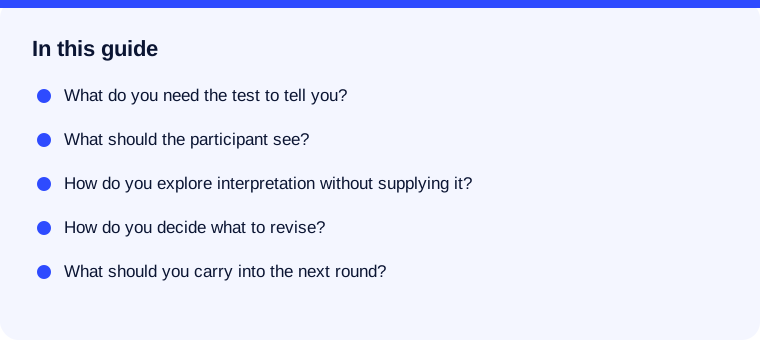
What do you need the test to tell you?
Start with one decision about a defined message: whether a description communicates its intended meaning, whether the situation feels relevant or whether a claim needs explanation. Keep the underlying offer stable while examining its wording. Otherwise a reaction may concern a different product or service rather than a different description.
A message can describe a service, a product or an idea. The worksheet works across industries. Choose people who have experience of the situation addressed, then record that experience alongside their response. A favorable response from someone outside the intended audience does not answer your audience question.
| Your question | Study to consider | What remains unresolved |
|---|---|---|
| What does this sentence mean to a reader? | A conversation with the message visible | How common that interpretation is |
| How widespread is an interpretation? | A separately designed audience survey | Whether the message changes behavior |
| Does changing the wording affect an action? | A separately planned behavioral experiment | Why a reader interpreted it that way |
Use the table to set the study scope. It is a planning aid, not a statistical design.
What should the participant see?
Prepare the exact message and enough surrounding context to understand where it appears. Keep the intended interpretation in your study notes rather than on the material you show. Record the version, intended audience, location and decision before the first conversation.
For example, imagine a service described as “review support.” Your intended meaning might be help organizing material for a reviewer. A reader might instead expect the service to make the decision. This is a hypothetical ambiguity to investigate, not a finding about an actual service.
- Mark the precise sentence being examined.
- List the capabilities the description is meant to communicate.
- Flag any claims whose supporting evidence is missing.
- Keep a copy of the material beside the notes for that session.
How do you explore interpretation without supplying it?
GOV.UK interview guidance recommends open, neutral questions and follow-ups grounded in specific experiences. For this worksheet, begin with relevant context, then let the person read before you explain.
- What do you think this describes?
- Which words helped you reach that interpretation?
- Who would this seem useful for?
- What recent situation, if any, does it bring to mind?
- What would you need to understand before considering it?
If a participant asks for clarification, first record the question and the interpretation that prompted it. Then clarify and label the subsequent response separately. Do not merge an unaided answer with one that followed your explanation.
How do you decide what to revise?
Use the following original worksheet. Each row is a possible observation, not a research result. Add the message version, participant code, supporting note and an alternative explanation before choosing an action.
| Possible observation | Decision to consider | Stop rule |
|---|---|---|
| The reader assigns responsibility to the wrong party | Rewrite the sentence to identify who does what | Do not add a capability to make the interpretation true |
| The reader understands but gives no relevant use | Investigate the audience and situation | Do not keep polishing wording without a use case |
| The reader requests support for a claim | Supply substantiation or narrow the claim | Do not replace missing evidence with stronger language |
| The reader prefers a sentence but misunderstands it | Resolve meaning before assessing preference | Do not choose a version on preference alone |
What should you carry into the next round?
Review observations by audience experience and message version. Preserve conflicting interpretations. Write a revision note containing the old wording, the proposed wording, the evidence behind the change and the unanswered question. If versions were shown in a different order, keep that context in the record.
These conversations provide material for a focused revision. They do not establish market-wide prevalence or a conversion effect. If the real uncertainty concerns the problem rather than the wording, return to customer discovery preparation.
Wavelength helps companies hold research conversations with people in their ICP. Use the B2B research recruitment page to discuss the participant experience needed for your study and agree on its scope.
Talk with Wavelength about the buyers you need to meet
Wavelength helps technology companies hold research conversations with relevant executives and operators in their ICP, for customer discovery, product feedback and market insight. Read about our B2B research recruitment service, or tell us about the audience you want to learn from.
Tell us who you want to meetCommon questions
Should we show more than one message?
Only when comparison answers the research question. Record the order, discuss each version separately and keep the reasons for a preference alongside the preference itself.
Is message testing the same as testing an offer idea?
This worksheet examines how a defined offer is explained. If the offer itself changes between versions, record that difference and treat the session as evaluating both the idea and its description.
Evidence that wording changes answers
A 2019 Pew Research Center experiment randomly varied a question about local job availability. The share saying jobs were plentiful was 60% for jobs and 48% for good jobs, a 12-percentage-point difference.
This was a public-opinion survey, not a marketing conversion test. It shows why wording deserves deliberate testing, but does not predict the lift a headline will produce. Keep interview prompts consistent and distinguish comprehension from preference. If the uncertainty is about the offer itself, start with concept testing; use these neutral customer interview questions for background context.