
The short answer
Voice of customer research identifies and organizes customer needs to inform decisions about a product or service. Begin with a decision, gather relevant customer experience, and distinguish an expressed need from a proposed solution. Use qualitative conversations to investigate meaning before choosing how to measure priorities.
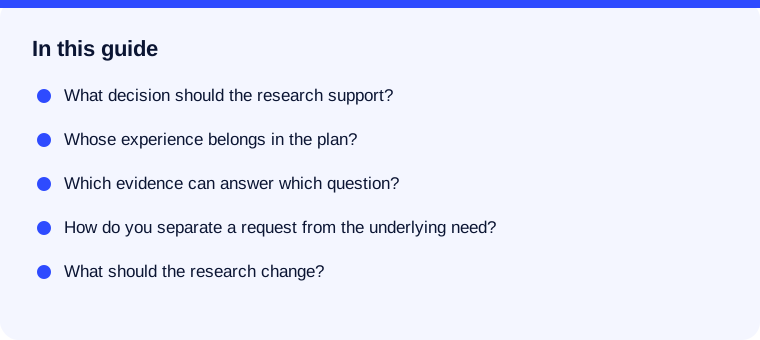
What decision should the research support?
Write the decision before collecting more feedback. You might need to understand why a task remains difficult, whether different roles need different outcomes, or which unresolved need deserves further investigation. Define what would change your current view.
The Voice of the Customer, hosted by MIT Sloan, describes a process that captures customer requirements, organizes needs and investigates priorities. It distinguishes qualitative and quantitative steps. A set of interviews can help you understand a need without measuring its prevalence.
Use this guide to plan the evidence you need. If your immediate task is learning how to run a conversation, start with the customer discovery interview guide.
Whose experience belongs in the plan?
Use this original coverage matrix before deciding which people to speak with. Describe actual involvement in the task rather than relying on titles. Keep existing customers and prospective buyers distinguishable in your notes.
| Perspective | Evidence sought | Boundary to record |
|---|---|---|
| Person doing the task | A recent attempt, obstacle and desired outcome | May not know approval requirements |
| Person reviewing the output | What makes the result usable or unacceptable | May not see the effort required to produce it |
| Person authorizing a change | Conditions for changing the current approach | May not experience the task directly |
| Relevant person outside the customer base | How the same problem is handled elsewhere | Cannot describe experience of your product without having used it |
Add columns for evidence already available, missing perspective and next research question. These are planning categories, not mandatory roles for every study. If one person performs several roles, preserve that context instead of counting their account as independent perspectives.
Which evidence can answer which question?
Choose evidence for its relationship to the decision. Use the table as a planning aid, not a requirement to collect every type.
| Question | Useful evidence | What remains unresolved |
|---|---|---|
| What does this request mean? | A conversation about the situation that prompted it | How widespread the need is |
| Does the difficulty happen during the task? | Observation of a relevant attempt, with permission | Whether other contexts differ |
| How do defined groups rate a need? | A suitably designed survey with a clear sampling basis | Whether stated priorities predict behavior |
| Did a change alter actual use? | Relevant behavioral evidence and an appropriate comparison | Other explanations for the change |
Keep the source, context and collection period attached to each observation. Avoid merging different versions of a product or different audience definitions into a single apparent consensus.
How do you separate a request from the underlying need?
GOV.UK interview guidance recommends open, neutral questions grounded in real examples. Ask the participant to describe the event behind a request before proposing a solution.
The following original worksheet contains a hypothetical example, not a finding from Wavelength research.
| Field | Hypothetical entry |
|---|---|
| Request | A shared status display |
| Situation to investigate | A reviewer could not tell whether work was ready for review |
| Provisional need | Know when an item is ready without interrupting its owner |
| Alternative explanation | The readiness rule itself may be unclear |
| Next question | What indicated readiness in the most recent successful handoff? |
Record the participant’s account separately from your proposed need statement. Ask about a contrasting occasion when the task went well. Preserve disagreement rather than rewriting different experiences into one convenient requirement.
What should the research change?
For each decision, record the need under consideration, evidence that supports it, contrary examples, missing perspectives and a bounded next step. Use labels such as investigate, clarify or test. Avoid calling a need universal because it appeared repeatedly in selected conversations.
If the next step is exploring a proposed solution, use the concept-testing guide to prepare the idea consistently. If the audience is still unclear, refine the coverage matrix first.
Wavelength helps companies hold buyer conversations, customer discovery and market-insight sessions with people in their ICP. Discuss the audience and purpose through B2B research recruitment. Agree the project scope and responsibilities before treating any broader evidence program as part of the engagement.
Talk with Wavelength about the buyers you need to meet
Wavelength helps technology companies hold research conversations with relevant executives and operators in their ICP, for customer discovery, product feedback and market insight. Read about our B2B research recruitment service, or tell us about the audience you want to learn from.
Tell us who you want to meetCommon questions
Is voice of customer research the same as a satisfaction score?
A score answers a defined measurement question. A needs study asks what people are trying to accomplish and what gets in their way. Choose evidence according to the decision, and keep the two purposes distinct.
Can prospective buyers contribute?
They can describe relevant needs and current alternatives. Label their evidence separately from that of existing customers, especially when discussing experience of your product.