
The short answer
A voice of customer survey is a structured questionnaire about customer experiences, needs or perceptions. Start with a defined audience and decision, ask about a specific experience, and test whether people understand the questions before using the answers. Keep survey responses separate from evidence about actual buying behavior.
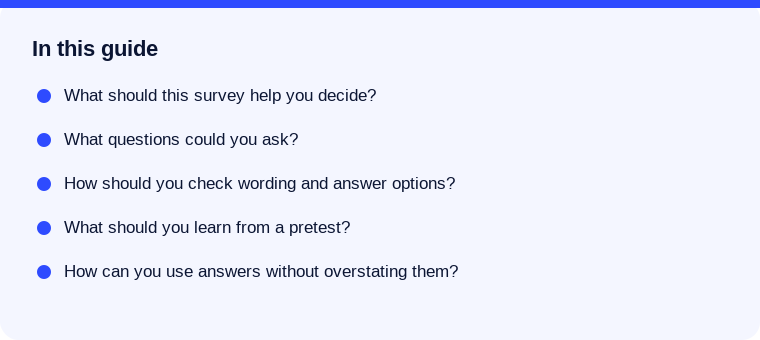
What should this survey help you decide?
Write the choice the team faces before listing questions. For example, a team might need to decide which part of a customer handoff deserves a closer investigation. That question calls for evidence about the handoff, not a general opinion of the company.
Use the voice of customer research guide if you are still deciding whether you need conversations, observation or a survey. This worksheet begins after you have chosen to prepare a questionnaire. It is an original planning aid, not a validated measurement instrument.
Record the audience, the experience they must have had, the period you want them to recall and the decision owner. Define whether your unit is a person, an account or a particular event. Several people describing the same account are not automatically independent accounts.
| Planning field | Hypothetical handoff study |
|---|---|
| Decision | Choose which handoff difficulty to investigate next |
| Relevant audience | Customers who personally handed work to a colleague for review |
| Experience | The most recent handoff during the past month |
| Unit recorded | One person's account of one attempt |
| Limit | Reported difficulty does not establish its cause |
What questions could you ask?
The questionnaire below is a hypothetical example for a handoff study. Replace the task and recall period with terms appropriate to your study, then pretest the revised version. Before the questions, explain the study purpose and how answers will be used. Ask respondents to omit names and confidential business details from free text.
| Question | Response format | Routing or interpretation |
|---|---|---|
| During the past month, did you personally hand work to a colleague for review? | Yes; No; Not sure | Only Yes continues to questions about that experience. Others finish this task module. |
| Thinking about the most recent time, what were you trying to accomplish? | Optional short text | Keep the respondent's description before presenting a list of possible difficulties. |
| At the time you handed it over, was the work ready for review? | Yes; Partly; No; Not sure | Separate readiness from whether the colleague actually reviewed it. |
| How easy or difficult was it to make that handoff? | Very easy; Somewhat easy; Neither easy nor difficult; Somewhat difficult; Very difficult; Cannot recall | Keep Cannot recall separate from the middle response. |
| What, if anything, made that handoff difficult? | Optional short text | Allow an answer that says there was no difficulty. |
| What happened to the work after you handed it over? | Review completed; Review started but not completed; Review not started; I do not know | Use this as reported outcome, not a verified completion record. |
Keep questions only when their answers contribute to the stated decision. If the task involves several different kinds of handoff, decide whether to study them separately before interpreting a combined result.
How should you check wording and answer options?
Pew Research Center's questionnaire guidance explains that wording, answer choices and question order can affect responses. It recommends clear questions, one concept at a time, and response categories that cover reasonable answers without overlapping.
Review the example as a draft to challenge. Does “ready” have a shared meaning? Can someone distinguish making the handoff from the review itself? Does “past month” refer to a calendar month or the preceding month? Set a precise reference period in the final questionnaire.
Avoid a combined question such as “How easy and useful was the handoff?” A person may find it easy but unhelpful. Keep the ease question and add a separate usefulness question only if the research decision requires it.
Keep an open description ahead of suggested explanations when you want an account in the respondent's own terms. Pew describes how earlier closed questions can shape later open answers. Preserve the chosen wording and order when comparing future rounds; document any changes.
What should you learn from a pretest?
Pew's guidance also treats pretesting as an essential questionnaire-design step. For this worksheet, ask relevant people to try the draft and explain how they interpreted it. Treat confusion as a reason to review the question.
| Check | What to record | Decision before use |
|---|---|---|
| Meaning | What the person thinks the question asks | Clarify an ambiguous task or term |
| Recall | Which event they used to answer | Specify a period they can apply consistently |
| Options | Whether an accurate answer was available | Add or revise an option without changing the intended measure |
| Routing | Whether an inapplicable question appeared | Correct the route and check it again |
| Interpretation | What the team would conclude from the response | Remove conclusions the answer cannot support |
Hypothetical correction: A participant rates a handoff difficult because the review is unfinished, although passing the work over was easy. Separate the handoff task from the later review outcome and pretest both questions again. This example illustrates a possible ambiguity, not a finding from Wavelength research.
How can you use answers without overstating them?
Agree the analysis record before gathering responses. For each question, retain its wording, the eligible response base, missing answers and collection period. Report which customers the responses describe and which perspectives are absent. Do not treat a set of selected responses as a population estimate without a justified sampling and analysis design.
| Possible observation | Bounded next step | Conclusion to avoid |
|---|---|---|
| Respondents describe unclear readiness | Explore how readiness is established in concrete examples | All customers need a new feature |
| Ease ratings differ between roles | Check the tasks and situations each role described | Role alone caused the difference |
| Many answers cannot be classified | Review the question and coding definitions | Force ambiguous accounts into the largest category |
Keep a note beside each proposed action naming the evidence that would change it. If you revise the questionnaire after a pretest, identify that version separately so preliminary responses are not silently combined with the final study.
When should you return to a conversation?
A survey answer may identify a difficulty without explaining the sequence behind it. Choose a follow-up question that explores the specific event. For the handoff example, ask what indicated that the work was ready and what happened immediately afterward.
GOV.UK's in-depth interview guidance recommends open, neutral questions and stories about real examples. Use the customer interview question guide to prepare prompts that explore an account without supplying its explanation.
Wavelength helps companies hold buyer conversations, customer discovery and market-insight sessions with people in their ICP. Bring the audience definition and unresolved questions to B2B research recruitment to discuss those conversations. Agree responsibilities for any broader survey study separately.
Talk with Wavelength about the buyers you need to meet
Wavelength helps technology companies hold research conversations with relevant executives and operators in their ICP, for customer discovery, product feedback and market insight. Read about our B2B research recruitment service, or tell us about the audience you want to learn from.
Tell us who you want to meetCommon questions
Is a voice of customer survey the same as an interview?
A survey uses a structured questionnaire. An interview allows follow-up questions about an account. Choose between them based on the uncertainty you need to resolve, and keep their findings distinguishable.
Should every survey include a recommendation score?
Include a question only when it supports the study decision. The handoff worksheet investigates a specific experience; a recommendation score would answer a different question.
Can prospective buyers answer this questionnaire?
Only if they have the experience the questions require. Prospective buyers cannot describe using your product if they have never used it. Define a separate task or questionnaire for their actual experience.