
The short answer
Jobs to be done interviews explore the progress someone sought when choosing a product, service or different way of working. In a switching interview, reconstruct a particular decision from the earlier situation through the change. Record the alternatives, hesitations and desired outcome, then treat your explanation as a hypothesis to examine across other relevant cases.
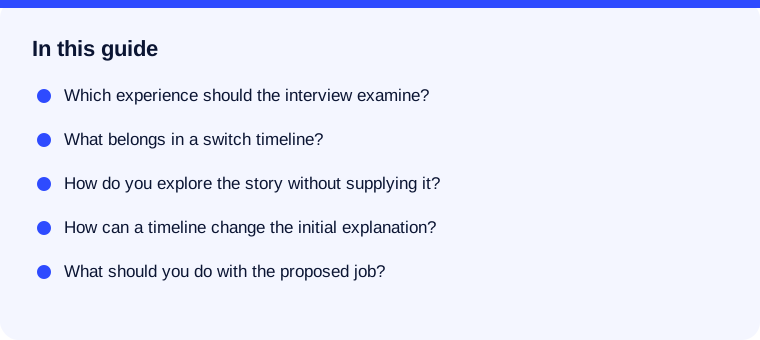
Which experience should the interview examine?
Start with a completed change that the participant personally experienced and can discuss without disclosing confidential information. Define the category of change before choosing participants. Someone who approved a decision may know why it became acceptable while someone who uses the new approach may know what changed afterward. Record which part of the story each person can actually explain.
Harvard Business School Online's interview assignment asks learners to investigate a purchase, the problem behind it, the trigger and the alternatives considered. This guide adapts that focus into a preparation worksheet for buyer conversations.
Choose this approach when the uncertainty concerns why a particular change happened when it did. For a broader investigation of an unfamiliar problem, begin with customer discovery interviews. For comparing the outcomes of evaluations of your offer, use win loss analysis. These questions may connect, but they need different organizing records.
What belongs in a switch timeline?
Use this original worksheet to prepare the conversation and organize the account afterward. The stages are prompts, not a requirement that every decision follow the same sequence. A search may pause, restart or overlap with a trial. Keep the order the participant describes and mark dates as approximate when necessary.
| Stage to explore | Prompt for the conversation | Evidence to record |
|---|---|---|
| Earlier situation | How was the task handled before this change? | Previous approach and what still worked |
| First disruption | Describe an occasion when that approach became difficult. | Specific event and its consequences |
| Active search | What happened between noticing the difficulty and looking for another approach? | Trigger for action and any waiting period |
| Alternatives | Which possibilities received serious consideration? | Actual options, including adapting the existing approach |
| Hesitation | What made it difficult to move ahead? | Uncertainty, dependencies and reasons to stay |
| Commitment | What changed immediately before the decision became definite? | Event, approval or condition described by this person |
| Use afterward | What happened when the new approach was first used? | Observed experience, separate from earlier expectations |
Beside each entry, add the source note, the person's involvement and what remains unknown. Do not invent a date or an event to make the timeline look complete.
How do you explore the story without supplying it?
GOV.UK's in-depth interview guidance recommends open, neutral questions, concrete stories and follow-ups. Ask the participant to explain an event before suggesting an explanation for it.
If someone says the previous approach was slow, ask them to describe the occasion they have in mind. Explore what was waiting, who noticed and what they did next. If they mention a deadline, establish when it became relevant rather than assuming it caused the purchase. These are suggested follow-ups for this worksheet, not a validated questionnaire.
Leave room for an earlier approach to have advantages. Ask what the person wanted to keep and what they worried might be lost. Avoid treating every hesitation as an objection that needs to be overcome. The purpose is to understand the decision.
Near the end, read back the sequence in plain language and invite corrections. Ask which details the participant witnessed and which they learned later. Mark disagreement or uncertainty in the notes instead of resolving it on their behalf.
How can a timeline change the initial explanation?
Hypothetical teaching example: a team changes how it organizes recurring review work. An initial summary says it wanted a more convenient process. The timeline below explores a narrower explanation. It is an original illustration, not a Wavelength finding or a customer story.
| Moment | Hypothetical account | Question still open |
|---|---|---|
| Before the search | The established review routine worked while the same people attended. | Was attendance the relevant difference? |
| First difficulty | A substitute reviewer could not tell which items were ready. | Was readiness unclear or was access missing? |
| Alternative considered | The team tried a written handover before considering a different approach. | What made that adjustment insufficient? |
| Delay | The person responsible worried that changing the routine would interrupt reviews. | What interruption did they expect? |
| Commitment | The team agreed on a transition point after finishing the current review. | Who agreed, and what did each person know? |
A provisional explanation might be that the team wanted review work to continue when the usual participants were absent. A competing explanation is that unclear readiness rules caused the difficulty regardless of attendance. The timeline makes that disagreement visible; it does not settle it.
What should you do with the proposed job?
Write a plain-language hypothesis that names the situation, the progress sought and the constraint. For the hypothetical example: when a substitute takes over a review, the team wants to identify ready work without interrupting the people preparing it. Keep the desired progress separate from a proposed feature.
Attach the timeline entries that support the hypothesis, the alternative explanation and the next question. Compare another relevant case to find where the explanation stops fitting. Do not merge accounts simply because the participants have similar titles. A stated reason after a change is an account to examine, not proof that the same condition will cause another buyer to act.
Use the following completion check before making a product decision: can you identify the earlier situation, an actual alternative, a reason to stay, the event before commitment and an unresolved detail? A missing item is a question for further research, not a reason to complete the story from intuition.
Wavelength helps companies hold buyer conversations, customer discovery and market-insight sessions with people in their ICP. To discuss access to relevant experiences, bring the category of change and participant criteria to B2B research recruitment. Confirm audience feasibility and session responsibilities before planning the study.
Talk with Wavelength about the buyers you need to meet
Wavelength helps technology companies hold research conversations with relevant executives and operators in their ICP, for customer discovery, product feedback and market insight. Read about our B2B research recruitment service, or tell us about the audience you want to learn from.
Tell us who you want to meetCommon questions
Do participants have to be customers of our company?
The useful qualification is firsthand experience of the change you are studying. People can describe a relevant change involving another approach. Do not assume access to a particular company's customers or request confidential details.
Can we study someone who decided to stay with the same approach?
Yes, as a contrasting case. Label it as a decision to stay and explore what happened. Do not give it a fictional switching date or treat it as the same outcome as adoption.
Does a jobs to be done interview establish demand?
It provides an account of a particular experience and material for a hypothesis. It does not establish market-wide demand, the frequency of a job or a future purchase commitment.